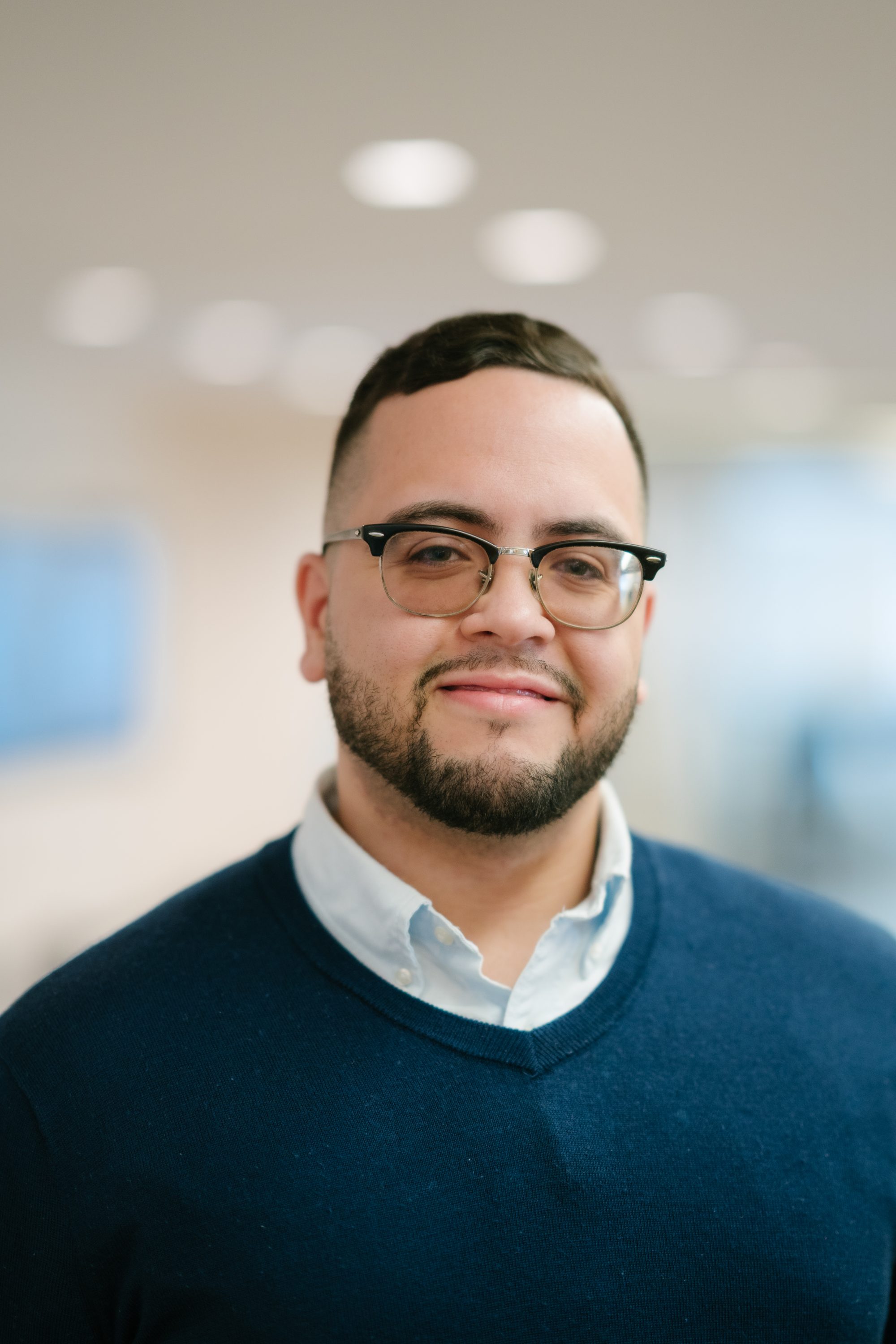
When John Nunez began his academic journey, he didn’t start in healthcare, he started in actuarial science. Drawn to data, analysis, and problem-solving, it seemed like a natural fit. But over time, John realized something was missing: a connection to people and a sense of purpose behind the numbers.
As John explored new paths, he found himself increasingly drawn to healthcare. It offered something his previous field didn’t: the opportunity to directly impact people’s lives.
“I’ve always been interested in technology,” he shares, “but I also wanted to help patients. Healthcare is where those two things come together.”
Today, John works as a Digital Pathology Technician at Mount Sinai Hospital, where he sees firsthand how technology is transforming patient care. But he also recognized a gap between rapidly advancing technology and how it’s applied in real clinical settings. That’s where health informatics came in.
Why SUNY Poly, and Why Now
John knew that advancing his career meant going back to school, but like many working professionals, flexibility was non-negotiable. “I was already interested in getting a master’s degree, but I needed something that would allow me to work full-time and still go to school,” he says. With a strong school reputation and a commitment to embracing technology, SUNY Poly’s Master of Science in Health Informatics stood out immediately.
The program’s flexible structure made it possible for John to balance his career and education without compromise, something he credits as a key factor in his success.
Just as important, his employer supported his decision. With approximately 95% of his tuition covered through employer benefits, John was able to pursue his degree without the financial barriers that often come with graduate education.
A Program That Connects Technology and Care
For John, pursuing the MS in Health Informatics wasn’t just about gaining technical skills. It was about understanding how to use those skills to improve healthcare systems.
He describes the field simply: “Health informatics is at the intersection of compassionate healthcare and technological innovation.” Through his coursework and industry-responsive assignments, John has gained hands-on experience with data systems and standards in healthcare, predictive modeling and AI applications, and real-world problem solving tied to industry needs. More importantly, the program has helped him see the bigger picture: how data, systems, and people all connect to improve outcomes. “It’s very cool to see things on the news that I’m actually working on in person.”
John even had the opportunity to conduct graduate research along Dr. Jerome Niyirora, Associate Professor and Program Coordinator of the MS in Health Informatics, through the Health & Bioinformatics Lab. He credits this one-on-one research experience with building the skills needed to thrive in today’s AI-driven world.
Support That Makes a Difference
One of the most impactful parts of John’s experience has been the faculty. “Professors are always available to guide and encourage me,” he says. Whether it was a quick email response, help navigating a complex assignment, or simply encouragement during a busy semester, John felt supported every step of the way. “I’ve even emailed back and forth with a professor throughout the weekend to ensure I understood the scope of an assignment correctly.” That level of access and responsiveness made it easier to balance the demands of full-time work and graduate study.
“The program faculty respect the whole student,” meaning they see the many responsibilities students juggle and go above and beyond to help students advance toward their academic goals while encouraging them to prioritize their personal commitments such as family and work.
From Graduate Student to Emerging Leader
John’s growth hasn’t been confined to the classroom. Through his role at Mount Sinai, he was selected to participate in his hospital’s Emerging Leaders Program, a competitive opportunity designed to develop high-potential professionals. His master’s degree played a key role in positioning him for that next step.
The combination of advanced technical knowledge, real-world application, and systems-level thinking helped demonstrate his readiness to lead in a rapidly evolving healthcare environment.
Today, John is focused on continuing to grow at the intersection of data, technology, and patient care, with long-term goals of moving into data science and analytics roles within healthcare. But more than anything, he’s confident he made the right choice.
To future graduate students considering the MS in Health Informatics, John says, “If you like healthcare and technology, and want to build a career, this program is for you. The coursework can be rigorous at times, but it will help you become a better professional – and personal – version of yourself.”