
When Shakeil Thomas ’25 reflects on her journey, it didn’t begin with a perfectly mapped-out plan. It began with a moment.
Working as a Patient Access Representative in a busy emergency room, she was often the first point of contact for patients. Every day, she handled critical patient information, but during the COVID-19 pandemic, something shifted. She saw healthcare differently.
“The pandemic opened my eyes to how important it is for healthcare workers to access, manage, and protect patient information, whether onsite or remote, while still maintaining the highest standard of care.” she shares. “It was during this time that I witnessed — in real time -– the budding relationship between technology and patient care, and that when leveraged appropriately, can reduce exposure, improve communication, and ultimately improve patient outcomes.”
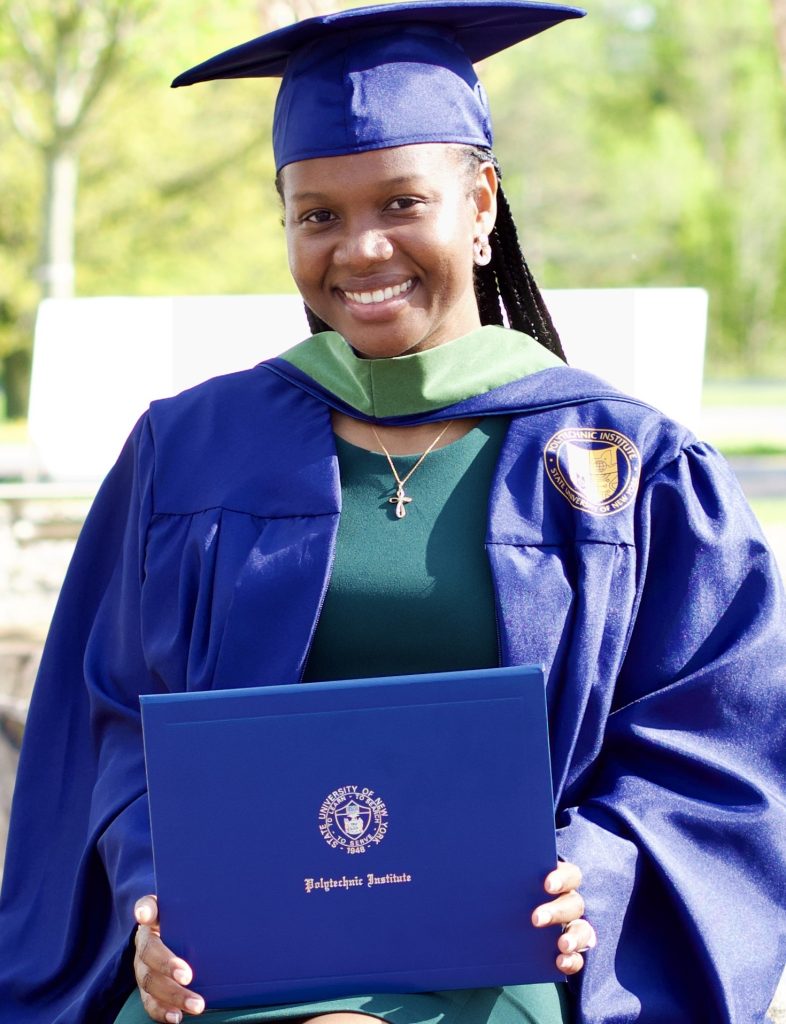
That realization sparked a new path: one that led her to SUNY Polytechnic Institute’s Master of Science in Health Informatics.
A Smart Investment in Her Future
For Shakeil, choosing a graduate program wasn’t just about interest. It was about value.
After earning her bachelor’s degree in Dental Hygiene in Jamaica, Shakeil discovered that practicing in the United States would require her to retake significant undergraduate coursework. Instead of repeating what she had already accomplished, she made a strategic decision: invest in a graduate degree that would expand her opportunities and move her forward.
“I was looking for something affordable, flexible, and aligned with my new career goals,” she explains. “SUNY Poly checked all the boxes.”
With competitive tuition, strong program outcomes, flexible part-time and full-time enrollment options, fully online asynchronous classes, and individualized guidance from faculty, the MS in Health Informatics offered a clear return on investment—not just financially, but professionally.
Instead of stepping away from her career, Shakeil was able to build on it. Today, she doesn’t just collect patient data. She understands how to use it to improve care, streamline systems, and drive better outcomes.
Built for Real Life—Not Put on Hold
Like many graduate students, Shakeil was already juggling work and life responsibilities. Graduate school had to fit into everything else, not replace it. “The flexibility made all the difference,” she says. “I could work and study at the same time, even when it meant long days and late nights.”
The program’s asynchronous format allowed her to learn on her schedule without sacrificing her goals or her income.
And when things felt overwhelming? She says, “I never felt alone.”
A Support System That Shows Up
One of the defining parts of Shakeil’s experience wasn’t just what she learned; it was who supported her along the way. “The faculty support was something I had never experienced before,” she says. “My professors were not only highly knowledgeable, but also incredibly warm and welcoming. They were always available to guide and encourage me — especially when I was trying to balance everything — and their support kept me motivated throughout the program.”
That support extended beyond the classroom. From peer study sessions to simple moments of encouragement, Shakeil found herself part of a community of students that understood the challenges of graduate study, often motivating one another to keep moving forward. “When I felt overwhelmed, I had people who reminded me why I started.”
Skills That Translate
Throughout the program, Shakeil didn’t just learn concepts. She built real, applicable skills. From coding in Python and SQL to data analysis, database management, and quality improvement tools, every course pushed her forward.
“It was exciting,” she says. “Everything we learned connected to what’s happening right now in healthcare—especially with AI and data.”
One standout moment? Competing in a global machine learning competition. In her final semester, Shakeil’s Quality Improvement professor encouraged her and her classmates to enter the Kaggle machine learning competition for the Titanic disaster. “This was brand new territory for me,” she says. “I ranked 1,598 out of over 15,000 participants. That was a huge accomplishment for me and proof of how far I’d come.”
Facing Doubt and Moving Forward Anyway
Shakeil’s journey wasn’t without challenges.
Moving to a new country. Starting a new career path. Learning in a fully online environment. Balancing work and school. “There was anxiety at the beginning,” she admits. “I wanted to do well. I didn’t know what to expect.”
But instead of letting fear stop her, she leaned into it. “I reminded myself: others have done this before me, and I can do it too.” That mindset, combined with support from faculty, peers, and her own determination, carried her through. “Even when I had moments of self-doubt, I remembered everything I’d already overcome before I even started this journey. I chose to believe that this is where I was supposed to be.”
Today, Shakeil is driven by a clear purpose: improving the quality of care for all patients.
“I’m passionate about reducing disparities in healthcare,” she says. “Data can help us identify gaps and improve outcomes, no matter someone’s race, gender, socioeconomic status, or geographic location.” She’s also focused on making healthcare systems more efficient and using technology to reduce repetitive work and improve workflows for providers.
It’s a future she didn’t just imagine—she built.
For Students Wondering “Can I Do This?”
Shakeil’s message is simple, yet powerful: “Don’t be afraid. Believe in yourself.”
Her journey is proof that you don’t have to pause your life to move forward. You don’t have to have it all figured out. And you’re not the only one balancing responsibilities, uncertainty, and ambition.
At SUNY Poly, students like Shakeil are doing it every day… building new careers, gaining in-demand skills, and creating meaningful impact.
Because here, your future doesn’t replace your present. It grows from it.