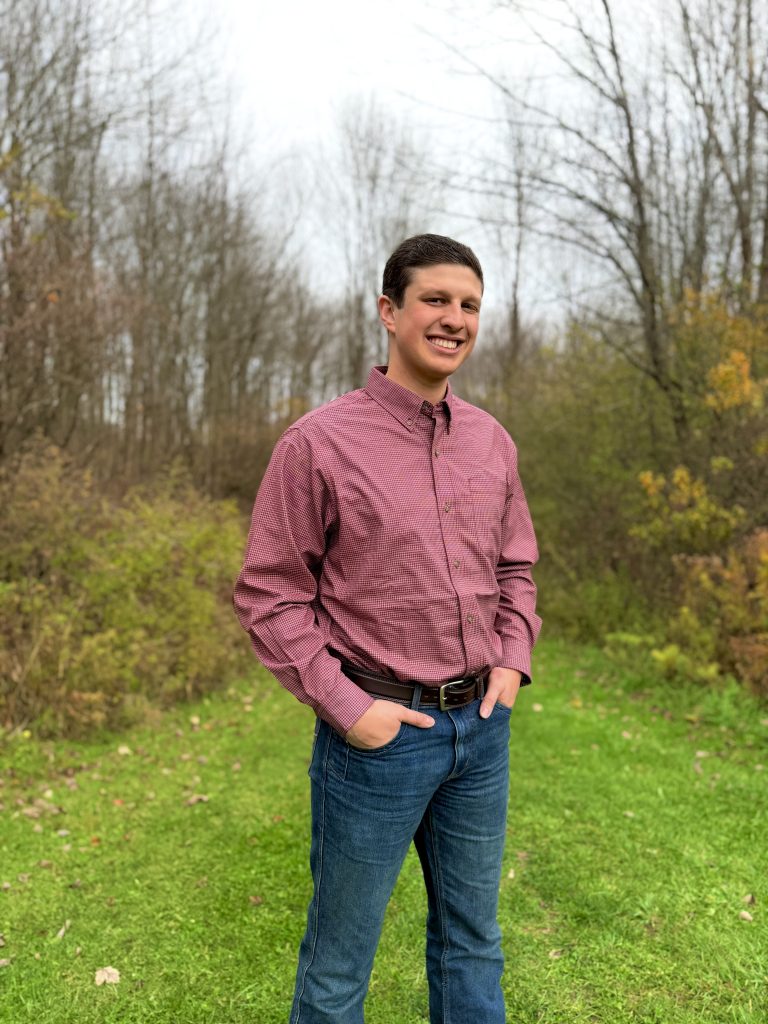
John Pertell ’26 isn’t just earning a master’s degree in computer science—he’s doing it in just four years.
A native of Northville, New York, a small town on Great Sacandaga Lake, Pertell took an accelerated path from the start. Through early admission, he completed his senior year of high school at Fulton-Montgomery Community College (FMCC), earning college credits before officially graduating high school in 2022. That head start, combined with SUNY Poly’s 4+1 computer science program, allowed him to seamlessly transition from his associate degree into both his bachelor’s and master’s.
“I really liked the 4+1 program,” Pertell said. “All of my credits transferred right to SUNY Poly, and the process was smooth.”
At SUNY Poly, Pertell initially knew he wanted to pursue computer science but hadn’t yet identified a specific focus. That changed through coursework and faculty mentorship. Classes with Dr. Amos Confer sparked his interest in embedded systems, leading to a nine-month internship at Fulton Thermal, where he worked on real-time embedded systems.
Later, an Internet of Things (IoT) course introduced him to wireless communication, an experience that would shape both his research and career path.
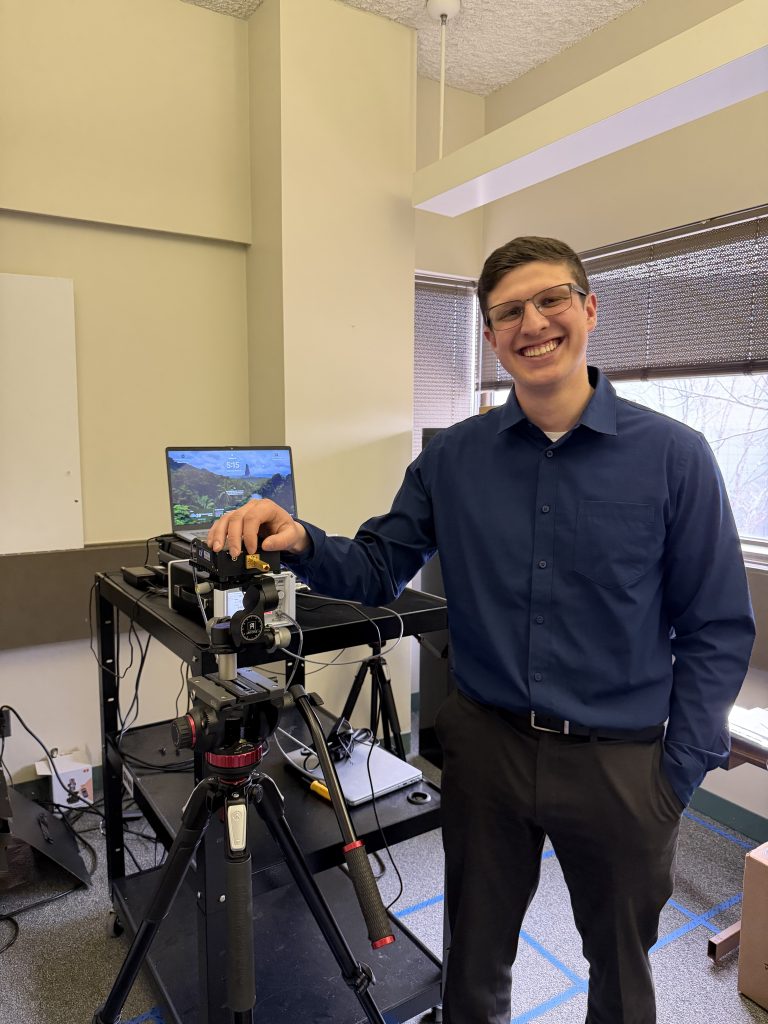
Encouraged by Electrical and Computer Engineering faculty member Dr. Priyangshu Sen, who is also involved in SUNY Poly’s WINGS Research Center, Pertell became involved in research focused on next-generation wireless communications. His work centers on a major challenge in the field: how to support the growing number of connected devices and increasing data demands.
For his first published paper, accepted to the European Conference on Antennas and Propagation in Dublin, Ireland that he will present in April, Pertell explored how wireless signals can be used not just for communication, but for sensing environments. His research analyzes how signals reflect off different materials and distances, allowing systems to better understand and adapt to their surroundings.
“The goal is to learn the environment so we can establish stronger, more efficient connections,” he explained.
That research experience also helped prepare him for his current role as a software engineer at Black River Systems Company in Utica, where he works on signal processing and wireless communication systems in a Department of Defense context. While his research leaned more into AI and machine learning, it gave him a strong foundation in the terminology and concepts used in his professional work.
Now working full-time while completing his master’s degree, Pertell is putting down roots in Utica and plans to continue his career locally after graduating in May.
Beyond academics and work, he has been deeply involved in campus life, serving as a resident advisor for three years, including as a graduate assistant RA.
Reflecting on his journey, Pertell encourages other students to find their niche early and fully commit to it.
“Pick what you like and what you’re really good at, and become the best at what you do,” he said. “Be as specific as possible.”
From early college credits to international research presentations, Pertell’s path shows what’s possible when opportunity, curiosity, and focus come together.